
By: Sophia von Seebach
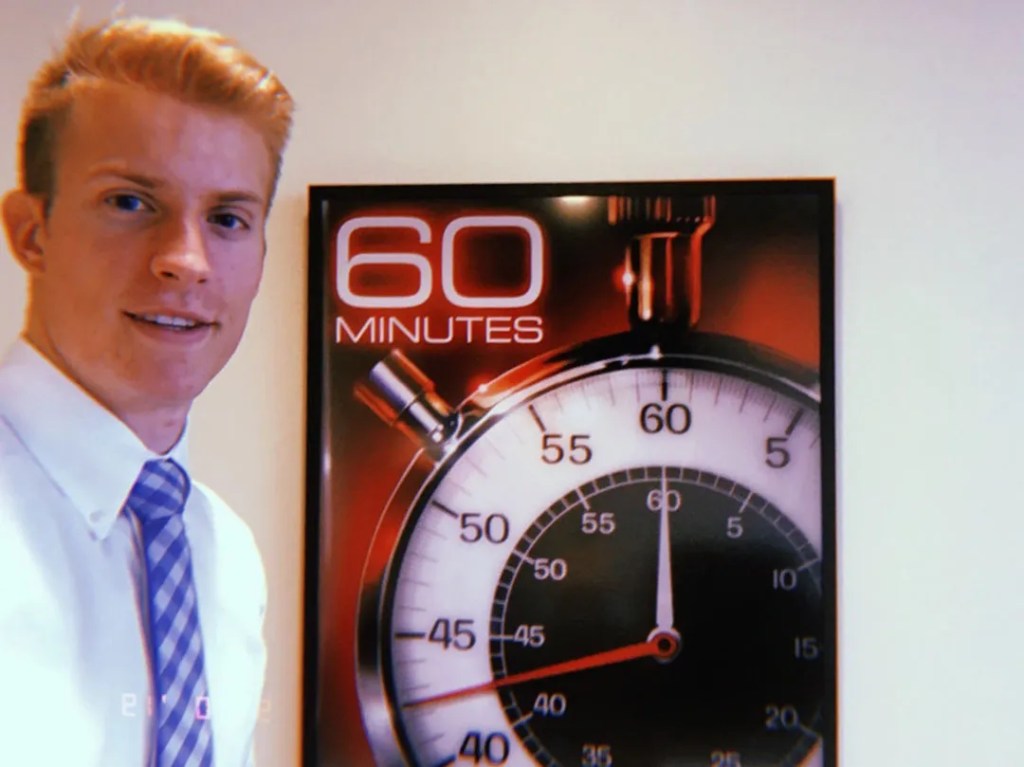
Matthew Hendley, the lead singer of skate-folk band Happy Landing, started the band a few months before he was set to graduate with a degree in broadcast journalism from the University of Mississippi. His career was fairly set, with the accolades such as winning first place in the TV Reporter category at the Louisiana-Mississippi Associated Press Broadcasters and Media Editors competition.
However, Hendley realized during an internship at CBS with 60 Minutes, that journalism may not be the field for him. Although his skill and dedication for the field was undeniably prevalent, Hendley’s first love was music.
Hendley learned to play music on his family’s farm as a young child, a place that was nicknamed Happy Landing. Hendley loved music for nearly two decades, and after careful consideration and sacrifice, he decided the time to take a leap of faith was upon him.
The career of the band is still early, but Happy Landing has gained substantial traction in the past two years. They have thousands of fans, specifically in Oxford, Miss., and their song “She’s Got Brooklyn,” now has over 100,000 views on Spotify.
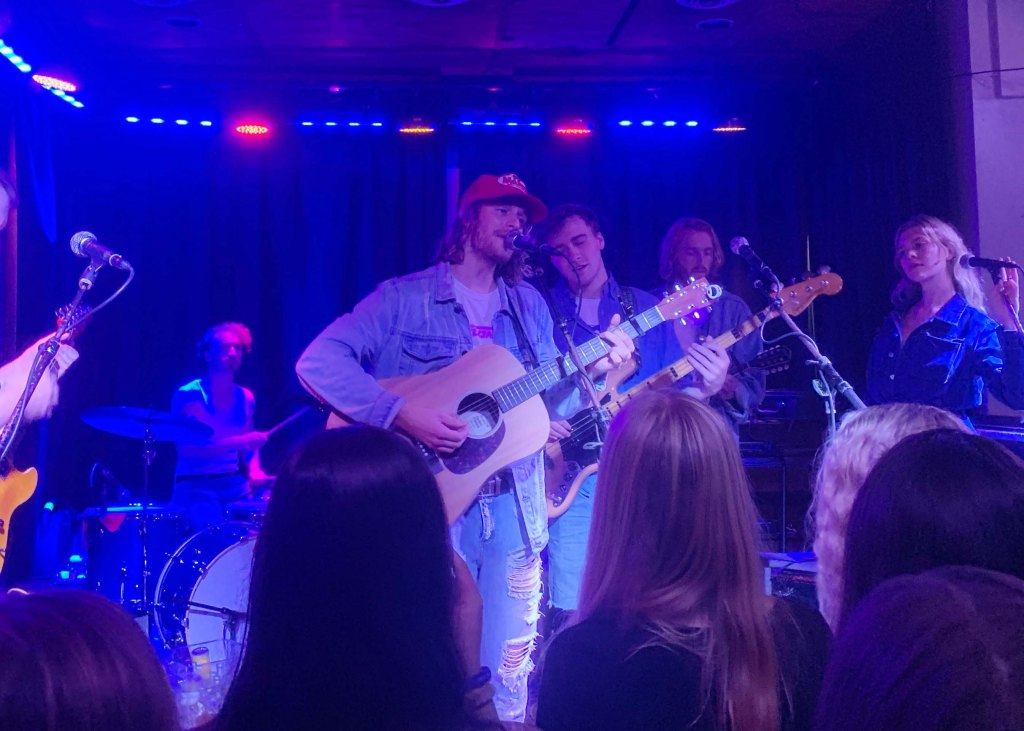
At the most recent show at Proud Larry’s, the crowd surged into the hundreds, and carried Hendley around the venue, in celebration of the band’s new EP release. Next he will perform, along with his bandmates, at Oxford’s Double Decker Arts Festival 2022.
So what has it been like since the last EP dropped?
We definitely feel like we have been gaining steam, with the release on Spotify, having the release show- it was kind of back, to back, to back. Now we have Double Decker coming up and we’re just trying to capitalize on this momentum we have. And just, yeah just keep coming back to our listeners, keep coming back to our fan base that we know, that we have support from. It’s been fun- it’s been fun to see something that you worked really hard at and really believe in. It’s cool to see other people start believing in it too.
It’s got to be exhausting. Every time I look at your Instagram you guys are doing a new show.
Yeah, it’s kind of overwhelming because we’re getting more and more shows, but we’re still at the point where we’re very small. Like we’re still doing everything ourselves, we’re doing all the marketing, we’ve been doing all of the booking, we’ve been doing all of the merchandise. It feels like everything is happening quickly and we’re just trying to stay on top of it. So yeah, but it has been exhausting, but it’s been cool too.
What was it like to have such a big crowd, the one at Proud Larry’s, chanting the lyrics back to you?
That was definitely the coolest part of the whole night and of the whole EP.
I’ve been trying to imagine what it’s like, for so long, to hear these people singing these lyrics and now it’s actually happening. So now, going back to listen to those live recordings, it’s like- ah, man it’s like a dream come true.
Well and Double Decker is coming up- they’ve had bands like Rainbow Kitten Surprise, Kings of Leon. That’s got to be interesting to see your name next to these bands that have been established for decades.
You fall in love with Double Decker when you’re an Ole Miss student and that was one of our goals too actually- we had two goals, really… The two main goals were ‘we want to play Double Decker and we want to play Red Rock Amphitheater in Colorado.’ And we’re playing Double Decker now, and we had no idea that would happen so soon. We thought it would take like five years or something. But to be able to do that so soon is kind of unexpected but super exciting.
I mean it’s just like this is a great festival and even if we’re at the very bottom of the poster, it’s just like, ‘hey, we’ll take any spot we can get, we just wanna play.’ And hopefully, in the next few years, we’ll just keep climbing up the poster. That’s the goal, at least.
So you were kind of the broadcast journalism superstar. I mean, Newswatch, an internship with 60 Minutes. So how did you walk away?
My experience with journalism and my experience with music- I’ve always had the desire for greatness, I guess. I always wanted to do really well at whatever I was doing. I don’t know, I think wherever you put effort in, you get rewarded, and I had these amazing opportunities from the School of Journalism to do these cool internships, and tell these cool stories.
But actually, it was during the 60 Minutes internship where I wrote our first EP. I was in New York, I wrote it- honestly, I wrote it at the desk at 60 Minutes when I wasn’t doing anything, like I was just writing songs, listening to music that inspired me. And I really credit that time in New York for inspiring me to be like ‘OK when I get back to Oxford in the spring, I wanna record these songs.’
But to answer your question, how I walked away from it- it’s a great question because I did feel like I was disappointing a lot of people in the journalism school. Especially like the deans, and the professors and my advisors. They all really believed in me and I felt that, so it was kind of hard to tell them ‘yeah, I’m actually putting this on hold and I’m just going to try music.’
But, what really helped- two of the people that I really respect- Dean Will Norton and Professor Michael Fagan, they understood, they saw the passion I had for music, and they understood that this is a very small window of opportunity, to make it in music. Like where you’re not married, you don’t have kids, you don’t really have any responsibilities.
So the opportunity presented itself to chase the music dream, and I just had to sacrifice getting into news. At least, right now.
What do you think a career in broadcast journalism has in common with live performances?
Ever since I was a little kid, I was a performer, right? So I knew I wanted to do things in front of people, if that makes sense. News really helped me hone that skill of being able to present myself well, the broadcast side of it. And the writing aspect of journalism helped me really learn how to craft a good story, one where people could relate to it.
I’ve written songs since I was 11 years old, that’s when I started and I never stopped. But it wasn’t until I started on the journalism path that I started realizing that it wasn’t about me. Like what I’m writing is not about me, it’s about how people relate to what I’m writing. Even if I’m writing about what I’m feeling, what matters is how people relate to what I’m feeling, how they find a piece of themselves in what I’m trying to say. I think news really helped me realize that.
So what about performing live is special to you?
I feel like these are questions my mom could answer better than me, like ‘I’ll tell you why my son is this way- because he’s crazy.’
It doesn’t mean I don’t get nervous when I’m in front of people or anything. But, to me, it’s an adrenaline rush like no other, really. Just being up there, it’s almost like the pressure and the eyes on me, makes me better. I don’t know, I just think that live performance really was just something I was born with. This desire to be in front of people and to do something that people are interested in. Like, to captivate someone is the coolest thing in the world.
When I was little people would always say ‘you just love attention and you’re obsessed with yourself.’ But, truly, as I’ve grown older and become more developed and more mature, I just really appreciate the skill that humans have to capture each other’s attention.
So you’ve experienced live music and you’ve experienced broadcast journalism. Now that you’ve done both, and have done both in a sort of big way, could you ever go back to broadcast?
I think about this a lot, because I think about the direction our country and our world is going in, and my mentor, Shepherd Smith. One time he gave me some great advice, he said ‘you just have to be able to see the forest from the trees.’ And he told me to think about this current moment, this present moment, and think about how it is going to affect the greater moment.
So when I think about that, I think ‘OK, what is society needing more and more’ as the world, it seems at least, is getting crazier and crazier.
I think in a dire circumstance, like war, or civil war- or I don’t know, some even greater political unrest in this country- I think it would be tempting to get back into news.
But right now, I feel that I am contributing to society in a different way. You know, because since things are so crazy, people want to relax and go enjoy a concert and dance, and sing and just experience some joy. So, I think that’s my role right now. If that changes in the future, I’ll answer the call. So, to answer that question, yeah I would go back. Honestly, I miss it a lot.
You said that you felt a little guilty for leaving broadcast, this career path that you and others poured time into, but more than that was there a fear? A fear of failure or lacking confidence?
Yeah, for sure. I think taking a leap of faith is always scary, but when it’s something you really, really care about and you have this strong desire to achieve, I think that’s even scarier. And leaving behind something that felt like a pretty clear path, like journalism, is kind of a double-whammy.
But honestly, our vocation is what’s going to scare us the most. If I felt super certain about what I was doing, and I didn’t doubt myself at all and I knew everything was going to be OK, it’s probably because it’s too easy and I’m meant to do something greater.
Dean Norton, the former dean of the journalism school, he was telling me ‘I believe in passion,’ that’s what he would say, and ‘whatever you’re passionate about, you should pursue.’ And so, I’ve kept that in my heart all throughout Ole Miss.
Well that leads me to my last question and this one might be a hard one... When you crowd-surfed at Proud Larry’s, was it as terrifying as it looked? Because it looked terrifying.
Haha, you know, actually I have some experience crowd-surfing. That was probably my fourth or fifth time. You think it looks terrifying?
~This interview has been edited and compressed for the sake of clarity.~
 Sophia's articles
Leave a comment